
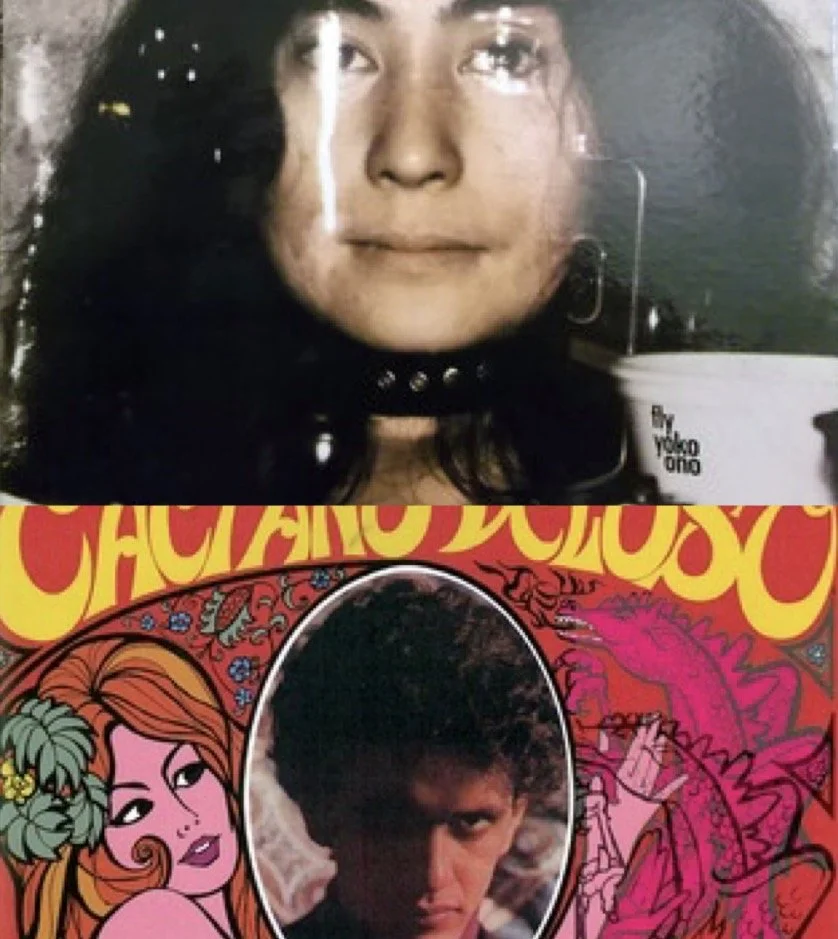
A Brief Word on Songs by Yoko Ono and Caetano Veloso
Presented here are two songs that have been in heavy rotation over the past few months. These two songs, though released just a handful of years apart, come from two vastly different artists, working in different contexts, different countries, and drawing from vastly different cultural backgrounds. What they have in common however are how they are reflective artist’s attempts to cope with the ever changing world they have found themselves in.
For Yoko Ono, it was the anxieties brought upon her new found global fame (and infamy) in relation to her marriage to John Lennon. For Caetano Veloso, it was coming of age in a military dictatorship at the cultural zenith of the 1960s. One is a stripped-back and somber reflection on a fracturing internal world while the other is a dense and bombastic anthem of youthful rebellion. Both of these tracks still, are deeply human displays of emotion that are more than worth your time as a listener.
"Mrs. Lennon" by Yoko Ono (Fly - 1971, Apple Records)
I’ve been very slowly working on a much longer piece about Yoko Ono. Her life, her legacy, her oeuvre, and how her pariah-like nature and public reputation has robbed us of this being a more mainstream discussion. I don’t even have the first draft of that finished yet.
What that essay will go into, even more than any Beatles or John Lennon related analysis of her work, is how her experiences as a childhood survivor of the Second World War influenced so much of her artistic output and the main themes of her career. The infamous screaming, yes, but also the word “imagine” (if that word has you raising an eyebrow, look up who has the sole co-writing credit on the song. But I digress).
If I was forced to choose a single musical moment to introduce Yoko Ono as an artist, it would be the lead single from her discography-best 1971 album Fly, “Mrs. Lennon.”
A four minute melancholic piano ballad, “Mrs. Lennon” invites such a rich intrigue at so many levels, it could probably warrant its own long form essay.
First, the music itself. It’s a sparse and somber tune; a marked departure from the two tracks it is sandwiched in between, both of which are rollicking blues-rock jams led by a wailing Yoko with the full might of the Plastic Ono Band behind it. Instead it is just her on vocals, John Lennon on piano, and Klaus Voorman on an understated bass. Its more conventionally pop ballading and themes of womanhood and self also serve to foreshadow her next solo album, 1973’s Approximately Infinite Universe.
Ono’s vocal delivery is deeply haunting, her words carrying the weight of the song's themes and the scars of life. On “Mrs. Lennon,” Yoko Ono grapples with the potential to lose her identity to her incomprehensibly famous husband, the break-up of the Beatles still a fresh wound to much of the public. These anxieties are metaphorically intertwined (but also likely reflecting very real psychological trauma) with the experiences of her childhood in Japan during World War II and its aftermath. She sings of checking the sky only to find that there are no clouds and looking onto the ocean only to see that there are no waves. When reflecting upon “husband John” extending his hand in marriage Ono remarks: “And he finds, and suddenly he finds / That he has no hands.” Yet she notes that they both have “lost their bodies” in each other. The final line of the song, which also appears almost exactly in the middle of it, reads simply: “Half the world is always dying you know.”
For Ono, death looms over her. Her real memories of the death and destruction during her wartime childhood and the potential for the death of her sense of self. Here she is grappling with a new trauma. Going from Yoko Ono — the acclaimed avant-garde artist, leader of the Fluxus movement, a contemporary of John Cage, Dick Higgins, and Nam June Paik — to just being “Mrs. Lennon.”
"Alegria, Alegria" by Caetano Veloso (Caetano Veloso - 1968, Philips Records)
Towards the end of the summer, I started listening to a slew of records produced in late ‘60s and early ‘70s Brazil. These records fell under the broad banner of “Tropicália.”
A radical art movement conjured up as a rebellion against the country’s military dictatorship, it was characterized on an aesthetic level by bright colors and an anything goes melding of the popular and avant-garde. Musically this meant the clashing of traditional Brazilian (or more accurately Afro-Brazilian) styles with the contemporary western psychedelia.
Despite its explicitly anti-dictatorship bend, the old guard of the Brazilian left decried it as vulgar and imperialistic, rejecting the idea that samba, bossa nova, forró, or any other music traditional to Brazil could be in communication with dominant western styles.The description I’ve given is reductive and still leaves out quite a bit of both political and musical context.
On October 21st, 1967, at the Third Brazilian Popular Music Festival, a made for TV song contest was held in an auditorium in São Paulo.It was here that a young singer-songwriter was met with what started as a chorus of boos and three minutes later exited the stage with a cavalcade of cheers. Sure — he had a handsome face and a million dollar smile — but the audiences were obviously captivated by the song being sung. That was Caetano Veloso debuting what would go on to become his signature tune: “Alegria, Alegria.”
One does not need a working knowledge of the Portuguese language (or the inclination to look up a translation of the lyrics) to understand, at least on a basic level, Veloso’s message.Its very architecture is that of a defiant anthem for disaffected youth. You can hear it in the iconic chorus. You can even read it in the title, which translates roughly to “joy, joy”.
The world of 1967 was not a calm and happy place. Although the following year would become equal parts infamous and legendary for the whole planet nearly falling apart, everything that happened in ‘68 was already almost to a boil by ‘67.
Brazil was no different. In fact, in many ways it was more severe. While politics, both foreign and domestic, played a major part in almost all of the youth, art, and music movements of that era, Brazil was under the direct rule of an authoritarian dictatorship. By 1969 Caetano Veloso’s music and lyrics would get him placed on house arrest in his native city of Salvador, before being forced into exile in England. That’s the context behind “Alegria, Alegria.” “Joy, joy.”
This context is what makes the track so poignant in its statement and gives way to understanding the stream of consciousness lyrics. I’ll get to that, but understanding the point of the lyrics, translated into English or heard in its original Portuguese, only shapes half the experience. “Alegria, Alegria” must also be heard for its bombastic sound.
In many ways, the song is one of the most late 1960’s sounding tunes ever recorded, yet it gets at something that made so many other iconic tracks of that era stand the test of time. It is a three minute parade of music. A flower-powery, George Martin and Paul McCartney-esque orchestra collides with the Afro-Brazilian rhythms that are embedded into the DNA of Veloso’s native Bahia state. If one had to describe it in a single sentence it would be: “All You Need is Love” performed at Carnival. But reducing it to a single sentence is incredibly reductive. “Alegria, Alegria” is not ‘60s psychedilia meets Brazil simply because it was a contemporary convenience; it reflects the dichotomy necessary to express the ideas of being a young person navigating all the contradictions of life in an unstable authoritarian regime located inside an increasingly chaotic world.
The iconic chorus previously alluded to, consists of two relatively ambiguous words: “eu vou” — or in English — "I go.” Although context is added by the pre-chorus of “no kerchief, no ID,” the overall interpretation is still intentionally made somewhat opaque.
Caetano Veloso continues to move through the chaotic world of ‘60s Brazil. He “goes” as headlines pass him by. One of the first lines I could make out from the original Portuguese was “bomba e Brigitte Bardot” — “bombs and Brigitte Bardot.” This perfectly encapsulates Veloso’s intentions of painting a portrait of the whirlwind decade unfolding. The bombs that were falling in Vietnam, Cambodia, the Middle East, Biafra, and so on, contrasted with the international icon and sex symbol, Brigitte Bardot. Many lyrics carry on this formula. For example the first verse contains the line (translated to English): “Spaceships, guerillas/and beautiful cardinales.”
By 1985, Brazil’s dictatorship would fall, though the Tropicalia movement had waned long before that. However, Caetano Veloso and several of his contemporaries have only seen their legend grow as the decades pass on. Veloso, who’s now in his eighties, still regularly performs. However, now when he goes to play “Alegria, Alegria”, the audience doesn’t boo. Rather, he is met with uproarious applause and an impassioned chorus of voices singing along to every word. Everyone is living in the moment, belting the chorus’ iconic mantra, “I go.”