Insipidity, Drugs, and Folk Rock: A Review of Daisy Jones & The Six , Episodes 1-3
“We could make a good thing bad” is the sentiment Daisy Jones (Riley Keough) and Billy Dunne (Sam Claflin) wail in the chorus of “Look at Us Now (Honeycomb)”, the lead single off the soundtrack to the brand new limited series, Daisy Jones & The Six.
They probably didn’t mean to comment on the show itself, but if the shoe fits…
Daisy Jones & The Six is an adaptation of Taylor Jenkins Reid’s novel of the same name. It’s a Frankenstein monster that falls somewhere between your cool-but-not-all-there uncle’s nostalgia-pilled trip down memory lane and a sensationalized Fleetwood Mac biopic where the sex, drugs, and rock ‘n’ roll fervor are traded in for lackluster chemistry and shiny, sterilized folk rock. The drugs are the only constant, but even that’s glossed over.
The miniseries was directed by James Ponsoldt, the mastermind behind gems like Porn ‘n Chicken (2002) and something starring Jason Segel and Harrison Ford that I refuse to research further, and Nzingha Stewart, who actually has a decently stacked filmography (I am choosing to overlook Netflix abomination Tall Girl.) For those who are unfamiliar with the book and/or series, it jumps back and forth between Daisy Jones & The Six’s formation and rise to stardom in the 1960s and 70s, and interviews with the band members in the late 90s, 20 years after the band’s unexpected demise.
I will admit it now: I went into watching Daisy Jones & The Six (henceforth referred to as DJS because I’m lazy) with some apprehension, because I didn’t go in blind. I read the book last year when it popped up on my Goodreads recommended reading list after my marathon of music memoirs and novels. I rated it pretty highly – 4 out of 5 stars – which falls marginally above my average rating of 3.89. It leaned hard on cliches, but it was a quick, inoffensive, beach read for those who fantasize about the 1970s in a heavily romanticized, I-know-better-but-the-clothes-and-music-rocked kinda way. That being said, the beauty of a novel is that you get to fill in the blanks yourself, so when the story is translated into an audio-visual experience, it either lives up to the expectation you set in your mind, or you’re left majorly disappointed. My experience was the latter.
The series opens with a young Daisy Jones – then called Margaret – singing along to a record while her hoity-toity parents host a party in the next room. Her mom comes in and tells her that she’s too loud, that no one wants to listen to her sing, that she’s an embarrassment, the whole kit and caboodle. The takeaway here is that Daisy/Margaret has got a bad case of mommy issues. The story jumps forward to a teenaged Daisy/Margaret loitering around the back of the iconic Whisky a Go Go. She sneaks into a show through the stage door and the music she hears changes her life. For some unknown reason, they picked The Byrds to be that band. Yawn.
Then we meet a young Billy, a talented guitar player who just has to get out of his small town. That town is Pittsburgh, Pennsylvania, and Billy is not like the other guys. He doesn’t want to get blown to smithereens in Vietnam or work at the mill, he wants to be a star! (Get in line, pal.) Billy is a hottie, all the girls want him, and he has a reputation around town. We’re introduced to his brother, Graham, who starts a band to impress a girl. Despite the approximately five minutes Billy spends pretending to be too cool for his little brother’s scheme, the man can’t resist a spotlight! Enter: the Dunne Brothers band.
In one particularly fiery scene, we’re introduced to a recurring character, Billy’s daddy issues. Billy sees his deadbeat father putting the moves on a woman half his age at a wedding the Dunne Brothers are playing. Seeming to gloss over his father’s perviness and moving straight to his absence, Billy smashes the guitar his dad gave him (before he abandoned his family) and Graham throws a wicked punch. Billy Dunne seems intent on proving something to his father, proclaiming that the Dunne Brothers are going to be the “biggest band in the world”. It’s just as corny and melodramatic as it sounds, and what Billy fails to realize is that while he’s clawing for success, his dad will probably be passed out in a stained recliner with a Playboy opened to the centerfold resting on his beer gut.
I won’t describe the rest of the show in this much detail, but these foundational scenes really set the tone for the rest of the series, so you gotta know what’s up. Anywho, there are mommy issues on the left, daddy issues on the right, everyone is severely screwed up in the head, and there’s no hiding it! Other than the childhood trauma, we learn nothing about Daisy or the Dunne Brothers that flush their characters out beyond the looming indication that their trauma is going to manifest itself in their adult lives.
Approximately 15 minutes into the first episode, it dawns on me what this whole series is about: it’s a signed and sealed ticket to internet virality through the gripping lens of nostalgia porn! We aren’t getting an endearing, original story, or multi-sided characters who really make you feel their feelings. We’re getting sexed-up celebrities wearing idealized 1970s fashion who do about as good of a job conveying emotion and selling the story as rocks with googly eyes. I’m just grateful I’m not on TikTok to see the aftermath.
For the first episode, Daisy just looms around the Sunset Strip and the afterparties, mingling with the glitterati but never quite pulling the trigger on her dream of singing. It isn’t until Simone Jackson – the most interesting and redeeming character of the series thus far – gives her a kick in the pants that she actually decides to do something with her life. But that kick in the pants isn’t without some good old fashioned anti-woman sentiment – there’s a lingering “not like other girls” energy in the air that makes the whole thing even more insufferable.
Simone tells Daisy that she isn’t like the other girls that hang out on the Strip, she’s there for the music, and the other girls are just groupies. The politics of the word “groupie” is a conversation for another day (and let me tell you, it’ll be a long conversation) but the notion that a) none of the other women at the shows care about the music, b) groupies are inherently uninterested in the music, or c) being a groupie is a bad thing was enough for me to need a break from the show. Simone is more talented than any of them, so I’ll give her a warning on the internalized misogyny and hope she moves past it. But I’m watching her closely…
On the note of “selling the story”, I was particularly put off by one scene, where Daisy plays at a dive bar piano. Except she doesn’t actually play, because it’s clear that Riley Keough never learned to play piano and they had to get around it through a series of extreme closeups. The song she’s not-playing has four chords, so it isn’t like anyone was asking for Bach-level piano proficiency. I had to pause the show and take another breather.
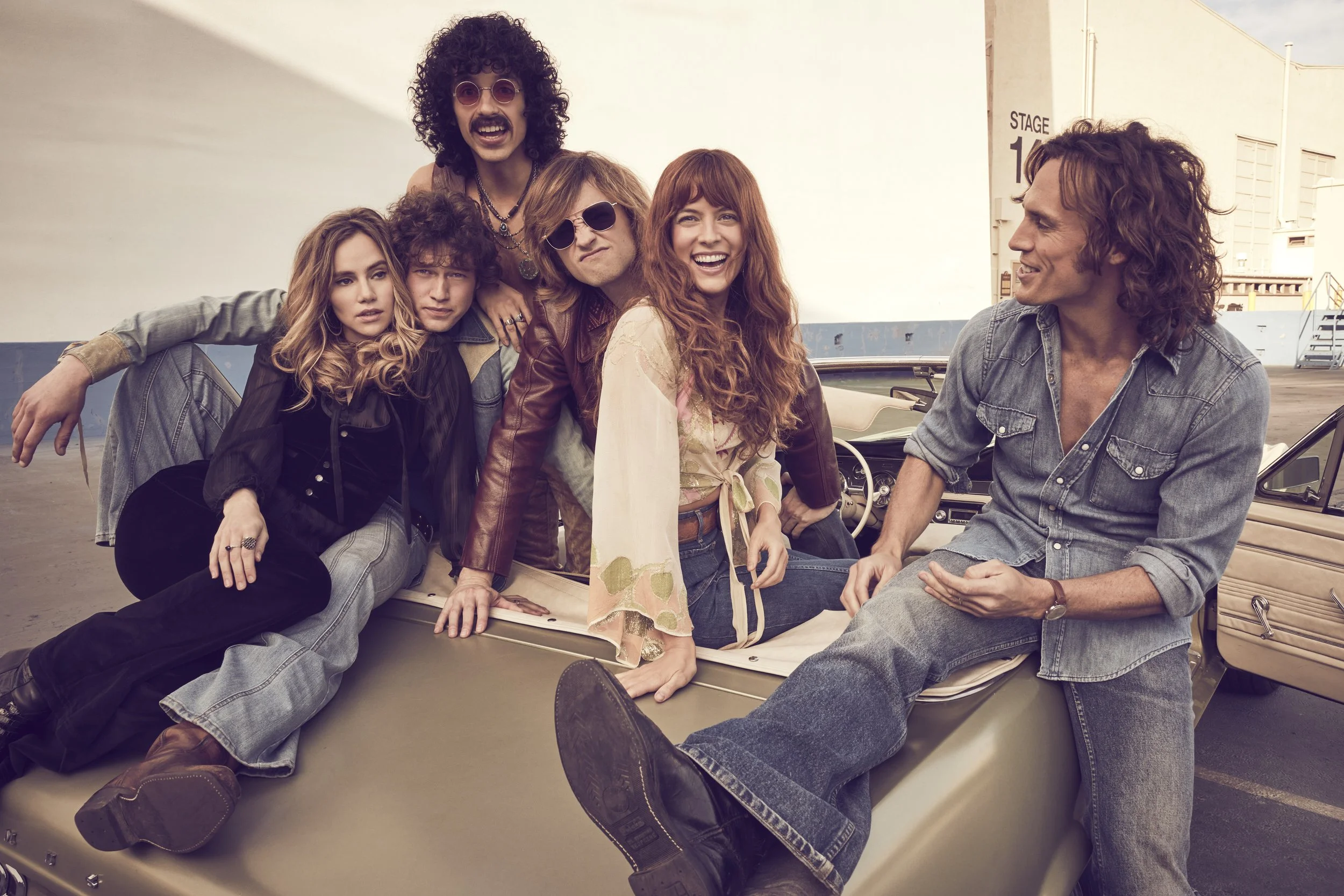
I’ll cut the cynicism for a minute. If there’s one thing DJS got right, it was the costumes. Denise Wingate put her entire soul into dressing the cast, and it shows. Dripping silk brocade evening dresses make an appearance in the early 1960s scene, in 1968, Daisy/Margaret hits the strip in a dress so short, it could be construed as public indecency if the wind blew, and the whole cast finally settles into fashionable Americana as the 70s roll around. Daisy struts around in drapey, diaphanous angel wing crop tops, suede hot pants, and drool-worthy fur-collared afghans, and I ate up every minute of it. Though it does beg the question: what the hell was the weather supposed to be when they filmed this?
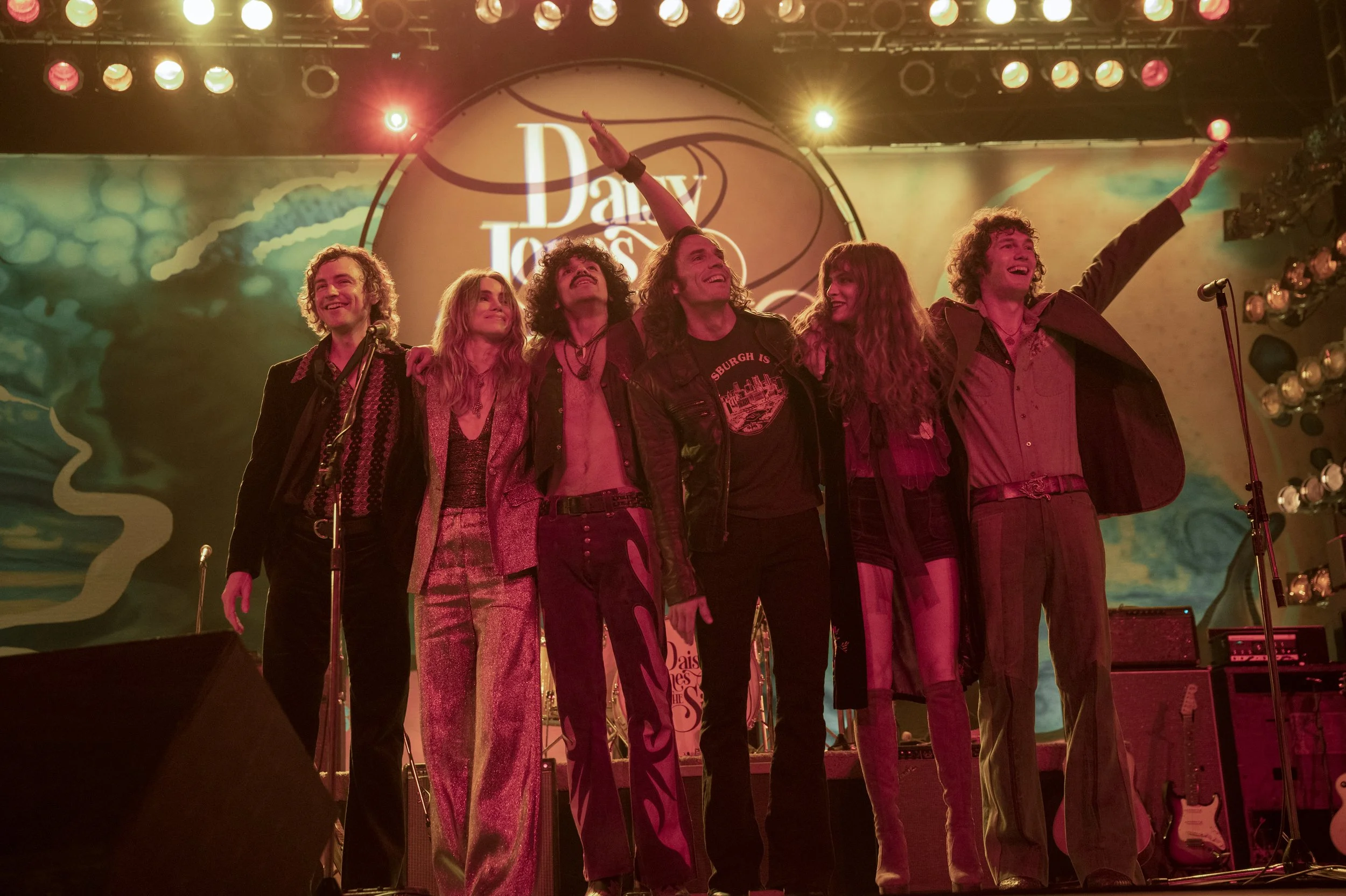
Back to being a hater! Possibly the worst part about the series is the notion that the Dunne Brothers are a groundbreaking band who the world needs to hear. Can they nail a cover of “Have Love Will Travel” by The Sonics? Sure. Can Warren Rhodes wallop on a drum kit? Absolutely. These are things I won’t deny, but I have to draw the line at the Dunne Brothers being anything more than… good. They face a few moments of very unconvincing adversity that are almost immediately met with the world bending to their will, they “slum it” in some dreamy Laurel Canyon estate while they have nothing to their names, and then suddenly, they’re huge. The music is so average, it feels like half of the more peripheral characters are there to convince us that what the Dunne Brothers are doing is worth paying attention to.
Billy Dunne is possibly the blandest, most mediocre character in the show. I wasn’t rooting for him at any point in the first three episodes, and was constantly baffled by the constant praise and admiration he was receiving from everyone around him. The whole “Exceedingly Average White Male Who Succeeds Because He’s Hot” trope is very true to life, but I know that this series isn’t self aware enough to be commenting on the music industry’s toxic double standards. We’re actually supposed to believe he’s God in Wranglers.
At one point in the third episode, while older Billy is being interviewed about his past in the band, he mentions that it’s “the same old rock n roll tale; drinking, the drugs, the loneliness”, and the interviewer responds, “That’s usually the end of the story. For you it’s the beginning.” It was supposed to be a cliff hanger to get us all invested in the rest of the story, but it just pissed me off. Yes, a fair number of rock stars died early in their careers due to the sometimes-lethal cocktail of alcohol, drugs, and loneliness, but “usually” is an exaggeration of epic proportions. Hell, if Mick Jagger, Lindsey Buckingham, and Robert Plant, among others, are still kicking, you can’t claim that the standard accouterments to rock ‘n’ roll are usually “the end of the story”. This is yet another attempt to push the “Billy Dunne is God” narrative on us.
Call me an apostate and burn me at the stake, because I’m not buying it.
In the third episode, the A&R guy who’s courting both the Dunne Brothers and Daisy Jones, Teddy Price, ends up having an “aha” moment and brings them together to record “Look at Us Now (Honeycomb)”. Though the episode ends with them in the recording studio, Billy attempting to keep up the hostile, tough guy act and Daisy floating above it all (she’s not like other girls, remember, she’s all about the music… ick), the enemies to lovers arc is clear from a mile away. And not because their chemistry sells it, because they’ve thrown so many tropes at the wall so far this one just has to stick.
The inadequacy of it all is amplified by the fact that the story is clearly supposed to take inspiration from that of Fleetwood Mac. “Look at Us Now (Honeycomb)” is just a cheap, melodramatic ripoff of Fleetwood Mac’s hit-of-the-century, “The Chain”, taking the steady kick drum and wailing, twangy guitars and leaving behind the passion and ingenuity of its predecessor.
The only note I made on the other characters was about the keyboard player, Karen, and it was to say that in her interview segment, she looked like she was wearing a “yassified Andy Warhol costume”. But that’s just feedback for the hair and makeup department and her stylist, so I won’t elaborate further. Let’s hope the next three episodes, dropping March 10th, can begin to redeem this series. You’ll hear from me either way.
Daisy Jones & The Six, you let me down… hard.