
INTERVIEW // Billie Marten on “Drop Cherries” and the Power of Self-Production
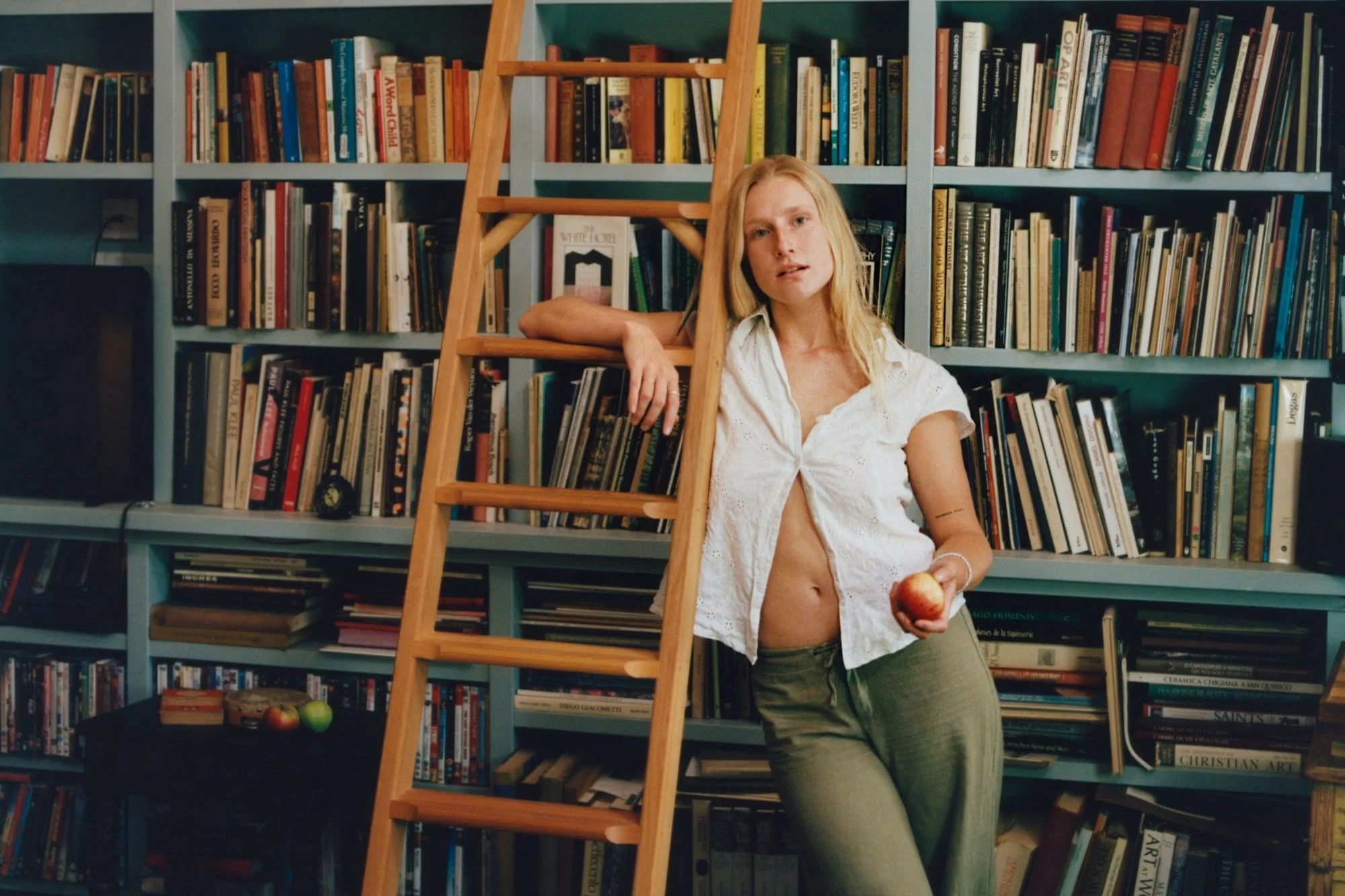
Photo: Katie Silvester
Billie Marten released her fourth album “Drop Cherries” in February of this year, going on to tour around the U.K. Now, she’s making her way to the U.S. for her very first North American headliner tour. Marten is booked to play two nights in New York, one at the Bowery Ballroom and the other at Rough Trade.
Marten, who turned 24 a few days before I spoke with her, originally found fame on YouTube 12 years ago. She released her first EP at 15 and has been continuously going since then, her first full-length album releasing in 2016. This latest album, “Drop Cherries,” is more of a concept album than any of her previous records, following moments of a relationship, from the intimate love shared to journeys of self-growth and discovery. The supporting short film shows Marten and her various musicians playing alongside each other in different areas of the house, from the intimate and echoey pool to the cozy in-house studio.
This album also marks her first voyage into producing her music, something she can never go back from, citing the importance of having ownership and accountability in one’s work, especially as a woman. The singer-songwriter vibe she brings to her work resonates deeply, with her velvety vocals and rich lyricism opening up a whole world of imagery.
A few days before she departed for the U.S. leg of the tour, she was kind enough to grace me with her sweet accent and gentle manner, where we discussed her new album and its supporting short film, her new label of co-producer, and, of course, Joni Mitchell.
Anna Forst: So first of all, happy birthday, you just celebrated your birthday a few days ago. And you're a Gemini, is that correct?
Billie Marten: That’s very sweet, thank you.
AF: Awesome. So how are you? You've been touring kind of along the U.K. and you're heading to California in just a few days. How are you feeling about being back on the road touring again? How is all that feeling?
BM: It feels like I would have really liked two weeks gap between the U.K. and the U.S., but you just thank your lucky stars. And I'm just impressed that my body has gotten me this far, so far.
AF: I can imagine that it's difficult to be on tour like that.
BM: I think just for the severity of U.S. touring, as well as all the different people, because it's so enormous, and it's so kind of monumental in all our brains, that just adds an extra bit of adrenaline to get you through that. I'm really looking forward to coming back.
AF: We're so excited to see you. Do you have any pre-show rituals or show rituals that you have maintained over time?
BM: With the band––with the U.K. band––that we just finished with, we turned to everyone in the room and we shake their hands, we pat them on the back and you say “Oh, great show” before we go on. It just sort of reinforces the fact that you don't even worry about it; what will be will be.
AF: What's been one of your favorite songs to play on this go around or kind of in general of you're performing?
BM: I really enjoy playing “I Can't Get My Head Around You” because it's kind of a sing along one, and then also there's a song called “Willow,” which is all about dealing with being in a relationship where you are apart from each other. And, it was written, actually, on the U.S. tour last year, so it reminds me of that time.
AF: That's lovely. I'm so excited to see it. If you could describe your latest album “Drop Cherries” and the supporting film in one sentence, or you know a sentence and a half, how would you describe it?
BM: Close to home. Natural in its most beautiful sense. Forgiving.
AF: It's a very romantic album. It's got a range of vignettes about things that happen in a relationship, the rises and falls, the metaphor of offering someone your love––stepping cherries into a clean carpet, as you said. Can you speak more to what in your life kind of led you to write about these themes and feelings?
BM: Honestly, it was just kind of borderless, writing about myself, because I've done it for so long. I think sometimes that well was dry, so it was pretty fantastic to have this album and songs that just kept flowing. You know, I just wanted to make this album somewhere else, and it was kind of a privilege to be able to do that. You often don't get a brief with an album, unless you're doing a concept album, you're kind of unsure as to where it's gonna go. You have to sort of add songs together and make them make sense of each other at times. Yeah, it was a much easier process. I think.
AF: Would you ever consider doing something more in the lines of a concept album, but with more of a fictional pull, something a little bit more out of your life experiences? Or do you draw most of your inspiration from personal experiences?
BM: I would love to be able to do that. But I don't think I have enough imagination to make it happen, I think. I think a lot of artists have a certain level of selfishness, in that inspiration comes when they feel something very deeply, or they've been going through something. So, it'll be a real challenge for me to come up with stories with no inspiration behind it, but I'm definitely after the challenge.
AF: Speaking of challenges, or maybe this isn't a challenge, but I saw that you wrote and co- produced this album––which I think I read was the first time you both wrote and co-produced a piece of your work––what was it like to be a part of the production experience?
BM: Well, I wanted to attach that role of the other to me, because the other producers will probably disagree with me that I kind of have always been co-producing in that seat. I love being in the studio and I love making those important decisions. I just had a conversation with Dom [Monks], the guy that I made it with, and wanted to check that he was okay with it being in a kind of equal relationship, and that I wasn't just giving him an album to produce. We share that title in a nice way. I could never go back to not having it [the title of producer], I think it's really important, especially for women in music, because everyone thinks that [women] have nothing to do with it anyways.
AF: Absolutely. I can imagine it's very thrilling to work on the music you've created and watch that process happen. Can you speak to any more about what it was like to be part of that experience?
BM: I can tell you, it was the most incredible time, but that’s because we were having different players come in each day, and the setup was changing constantly, so we were never bored. I was never isolated. I always had players to bounce off in the live room with, which made it more of a performance. I was just watching songs grow and take their twists and turns and never quite ending when you wanted them to, but getting there anyways. It always felt like the right decision.
AF: Speaking of having the performance aspect and having the players on site, the film, the short film you did for the album, was really spectacular. The one-take shot, the intimacy, the location of it (the house was beautiful)... I also love what you're wearing, your outfit was so cute. What inspired you to make a short film like this? And would you do another in the future, either related to an album or just in general?
BM: Yeah, I'd love to do it again, I think I think it's kind of the way forward. I've noticed a lot of scripts coinciding with live videos now and I think people really want… I think we're coming into a real age of vulnerability when people want people out there more. Perhaps the regular concept of music videos is maybe a little shallow for what people are thinking about. I didn't want to have to perform; performing for me is acting, whereas singing is incredibly honest. It was about capturing all the people that played on the record in one house together, sharing a very intimate scene along with very intimate songs, and making sure that people see that part of the process. Very raw. I mean, there are loads of mistakes in it. By far not my best performance at all. I actually hated it, when I first saw it. I didn't want to put it out, but everyone convinced me that that was the whole point, that it wasn’t meant to be perfect.
AF: It's incredible to hear you say that you didn't like it at first, but I understand that feeling of humility, you know, but just wanted to let you know, I really appreciate the fact that you put it out anyways and that you own the insecurities.
BM: I felt like, I can’t believe they let me go outside like that. I can’t believe they've given me a music career.
AF: I can imagine that must be a little daunting. And then to put it out, you know, with the new album, like here it is here! It's really incredible, though, I think..
BM: For everybody in the whole world, for the rest of time, it’s out there.
AF: Yeah, but I can't wait to see if you do any similar things in that vein or new things. And within that same vein, it's very exciting. It's a great new age of music and creating music for audiences.
AF: What's one book, one movie, and one record or album you read, watched or listened to either recently or kind of in general that you recommend to your listeners?
BM: One book would be Crossroads by Jonathan Franzen, who’s a U.S. writer, and the book is all about a family growing up in a religious cult setting in the U.S., and is really beautiful. One record would be Cymande, their self-titled album, I think it’s early 70s, mid-70s, is what I've been playing on the turntable a lot recently. One film, this is a really old film, but it’s called Another Round and is a Danish film with Mads Mikkelsen––he's amazing in everything that he does––all about older men feeling vulnerable and visible about male friendship. They’re teachers in this high school, and it’s just fantastic, the storylines are brilliant, as is the end scene.
AF: That movie is fantastic. I love Mads Mikkelsen, too, I think he's a phenomenal actor. So I definitely agree with you on that choice.
BM: Yeah, that was fantastic.
AF: All right. One more question for you. I don't know if you're allowed to answer this, but: Spotify or Apple Music?
BM: Tricky, controversial questions. I would say, I use Spotify more, but I agree more with Apple Music’s ethos.
AF: I'm with you there. I'm much more of a Spotify user, but the fact that I can't listen to Joni Mitchell on Spotify anymore does cause an issue in my life a little bit.
BM: It's a huge issue! What is happening about it?
AF: Yeah. I mean, we need to figure something out because I miss her dearly. Sometimes I just need some “Blue” in my ears.
BM: Yeah, when you're on the bus, or something, you need it!
AF: Absolutely!
AF: On Spotify, they give you that feature where you can see your top listened to artists or songs of the last year. Do you remember any top artists or songs from the last year, or songs that are on repeat recently?
BM: Old school Fleetwood Mac; Wings; Lou Reed; this band called Coco's are amazing; The Weather Station, she's also amazing; Kurt Vile’s live version of “Baby's Arms”, which I think is everyone's favorite song… every time I've been to someone's house, it's been playing, but I'm not bored of it yet, and it's been like four years.
AF: I can't wait to see the show. It was so nice to speak with you. Good luck on the beginning of your U.S. tour!
BM: Oh, thank you. Thank you very much.
AF: See you soon.
BM: See you soon.
Catch Billie Marten live in NYC at Rough Trade on June 21st and Bowery Ballroom on June 22nd.