Music in Movies: Punch-Drunk Love
On January 11th, 2023, I sat down for a casual viewing of Jeopardy, a show I only ever watched on plastic-covered sofas at my grandparent's house in Florida. I was confused when I heard the familiar “doo doo dooo, do do doo doo doooo…” jingle, wondering where I knew the song from. Of course, this is just the Jeopardy jingle, but it was so ingrained in my mind that I recognized the tune before I even connected it to the show I was watching. This moment reminded me just how much music is an integral aspect of TV and film. It has the power to replace dialogue, amplify emotion, and provide alternative meaning to what might otherwise be a one-dimensional scene. Though I’ve always loved musicals and movies where the songs are a focal point, like Damien Chazelle’s La La Land and John Carney’s Sing Street, the soundtrack for a movie of any genre can make or break it. Paul Thomas Anderson’s Punch-Drunk Love was the first movie I remember watching where I noticed how essential of a role the music played.
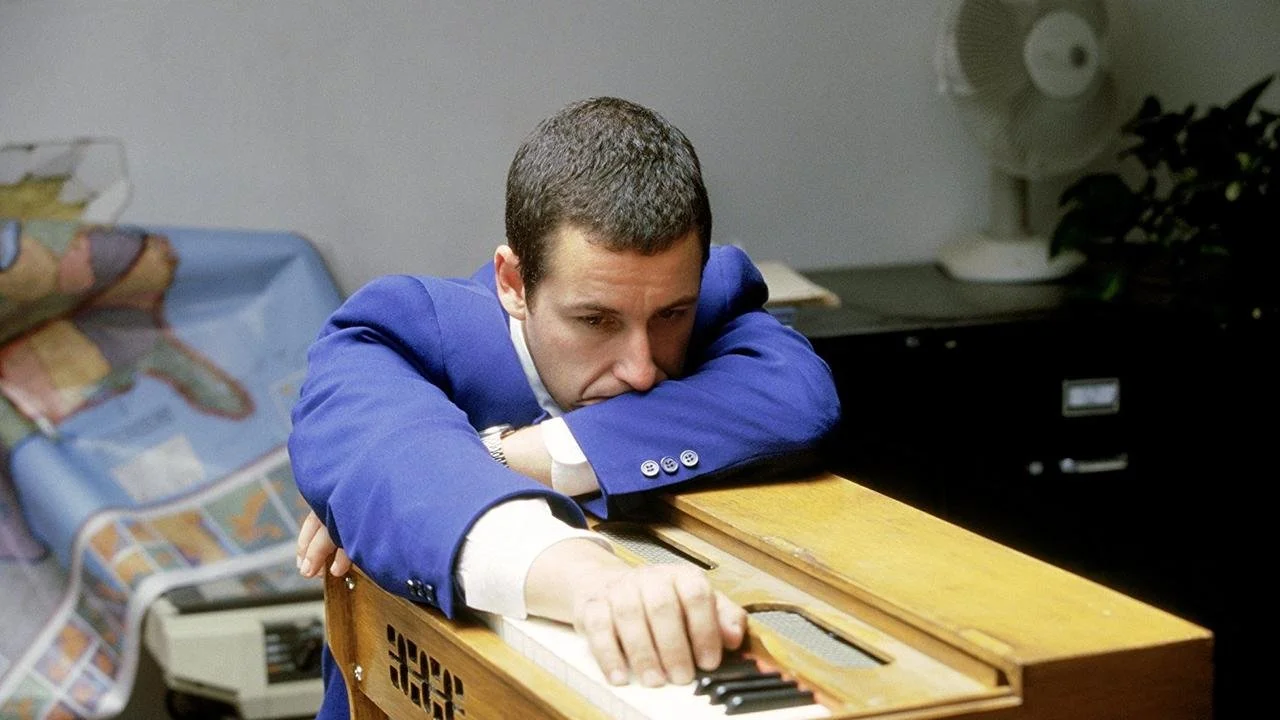
Punch-Drunk Love, released in 2002, is a drama starring Adam Sandler as Barry Egan, a reclusive businessman prone to violent outbursts, a target for scams, who is somewhat of a scammer himself. Jon Brion, the composer of the film, created a score that truly captures the feeling of the scenes and guides the watchers' reactions. The soundtrack begins about 3 minutes into the movie when a harmonium is dropped on the street outside Barry’s work. After some consideration, he brings it into his office, and it becomes a new outlet for his emotions, and his playing it serves as one of our biggest tells of when he’s frustrated unless he is punching walls or screaming violently. Five minutes later, as he’s cautiously exploring its capabilities, the first song of the film begins, a steady beat laying the groundwork for wandering notes. With the sudden crashing sound of the garage door opening to Barry’s new workday, the song fills out with interspersed, low, rumbling drums and long descending pitches. It soon swells into a major key and the title sequence of the film, featuring abstract colors blurring across the screen fills the watcher's eyes. The song ebbs and flows constantly, eliciting feelings of hopeful anticipation paired with fear-mongering minor notes, foreshadowing the tumultuous journey ahead.
Much of the movie takes place in Barry’s work, a large garage unit where he has his own office, equipped with a desk, phone, chair, and his new harmonium. Each scene in Barry’s workplace has a song behind it. These songs notably feature drums, which are often fast-paced and accompanied by other rhythm instruments, including what sounds like hand shakers, wind flutes, and maybe a marimba? The percussive music during Barry’s work scenes is to me some of the most powerful, partially because of how easily they could go unnoticed. The score makes sense for the setting — fast, unpredictable, and anxiety-inducing — just like work. The choice of filling what may seem mundane with emotion through song is, in my opinion, a great one. Without the score, these long sequences in a barren office may feel dull. As complementary as the score is to the scenes that are overtly action or emotion-packed (like when Barry gets chased by the bad guys or kisses his love interest Lena), the supplementary style of the music is what I enjoy the most. The workplace music becomes a predictable indicator of Barry’s emotions, a familiar enemy.
In contrast, the score fades out on Barry’s first date with the counterpart in his budding romance, Lena. This seems like an essential point in the movie, so one might want to capture the moment with a cheesy love song playing in the background of the restaurant. However, the only music in this scene begins after the couple is escorted out of the restaurant due to Barry’s bathroom-break-turned-demolition, a brief moment that’s also packed with intense, distorted sound. It’s only when they exit the restaurant that a symphony plays a sweet love song that ends quickly before swelling again as Barry runs back to Lena’s apartment after saying goodbye to kiss her, not just chastely on the cheek this time. The lack of music playing when Barry is with others, be it, Lena, on the phone sex line, or at his sister's party shows how much the score serves as the indicator of Barry’s inner monologue. When Barry isn’t alone the rumbling undercurrent of potential danger quiets.
A little over halfway through the movie one of my favorite moments in the score occurs:
Back at work, Barry is stressed out on the phone with a company doing a promotion where a certain amount of money spent on their food gets translated into frequent flier miles. Barry found their cheapest product, pudding, which he’s purchased ridiculous quantities of, and tries to redeem his collection so he can meet Lena on her business trip to Hawaii. Unsurprisingly, the loophole he thought he found isn’t working out as he had planned, and Barry begins to punch the wall, crying in agony. The phone falls off the hook, and a dial tone plays as Barry leans on his harmonium placing his hand on top of it, revealing scratched and bloodied knuckles that spell out “L-O-V-E”. All at once the dial tone ends and the first song of the film with vocals in it begins, a rework of “He Needs Me”, written by Harry Nillson for the 1980 Popeye movie and sung by Shelly Duvall. When I watched this for the first time I’d never heard the song before (it is now all over TikTok, a complaint I’ll save for another time), and it was an amazing moment. I’m pretty sure my jaw actually dropped and I rewound at least once. Brion mastered a sort of negative space with the music in the movie, so this song stands out as the focal point of the scene. How he managed to nail this so perfectly will never cease to amaze me.
The rest of the movie features the majority of the conflicts playing out, and the score continues to aid the movement of this action. As Barry’s struggles slowly get resolved, he returns to Lena confessing all that has transpired and apologizing for his occasional lackluster behaviors. The end of the movie showcases the harmonium once again, but now Barry sits at it with Lena embracing him. Maybe this is a sign that Barry has now found two necessary positives, a tool to express his emotions and a companion to love. Maybe not, maybe all of this is just my own flight of fancy blowing things out of proportion in a desperate attempt to attach meaning that relates to my thoughts and opinions. Regardless, this ending scene ties the motif of the harmonium back in and reaffirms the importance of music in the movie. The score in a film or show can be the missing puzzle piece to complete a picture that would make no sense without it. Punch-Drunk Love, in this metaphor, is the perfect puzzle.
Words: Lucy Roth