What’s Become of the Fillmore East
The Apple Bank on Second Avenue and East 6th Street is inconspicuous to today’s passerby, but during its time as Bill Graham's Fillmore East, it was known as the “Church of Rock and Roll” by critics and fans. From 1968 to 1971, the Fillmore East hosted the Grateful Dead, Jimi Hendrix, the Allman Brothers, Janis Joplin, and many more prominent 60s rock bands and artists. If a band played a great set at the Fillmore East, the entire music business would know about it the next morning.
The Fillmore East was the sister venue of the Fillmore West, a prominent part of San Francisco's entertainment since 1912 and thanks to Bill Graham, concert promoter and owner of the Fillmores, the venues were largely responsible for shaping the music scene in the mid to late 60s.
Born in Nazi Germany to Jewish parents in 1931, Graham was sent by his parents to an orphanage in France and finally ended up in a foster home in the Bronx without knowing a word of English. He served in the Korean war and after he was honorably discharged, moved to San Francisco to become an actor. He began performing in free shows in Golden Gate Park with the city’s Mime Troupe and when they were busted in 1965, he asked his friend Charles Sullivan, a successful Black businessman and owner of the Fillmore West, if he could put on a benefit to raise money for the troupe. At Graham’s first benefit in December 1965, The Grateful Dead, the Jefferson Airplane, and Quicksilver Messenger Service headlined. When Sullivan was killed in 1966, Graham took over hosting shows at the Fillmore.
After successfully hosting shows, Acid tests, and benefits at the San Francisco location, Graham bought the then-rundown Village Theatre in the East Village in on March 8, 1968, quickly turned it into the Fillmore East, and began its run on March 18 with Big Brother and the Holding Company supported by Albert King and Tim Buckley. With a great turnout the first night, the Fillmore East was set for success.
Not only was Graham a supporter of rock music, he also introduced the mainly white audiences who came to his shows music they may not know. He brought The Doors and Jimi Hendrix to San Francisco for the first time, and would book famous R&B artists like James Brown and Aretha Franklin on the same night. Attendees at a Graham show would never quite know what would happen at either Fillmore. Graham introduced audiences to B.B. King, Miles Davis, Lenny Bruce, and Otis Redding, and even hosted poetry readings.
The Fillmore East was known for its community and frequently hosted two-show, triple-bill concerts several nights a week. Gregg Allman of the Allman Brothers said in an interview that, “he was the best promoter rock has ever had and you could feel his influence in every little single thing at the Fillmore. It was just special. The bands felt it and the crowd felt it and it lit all of us up.”
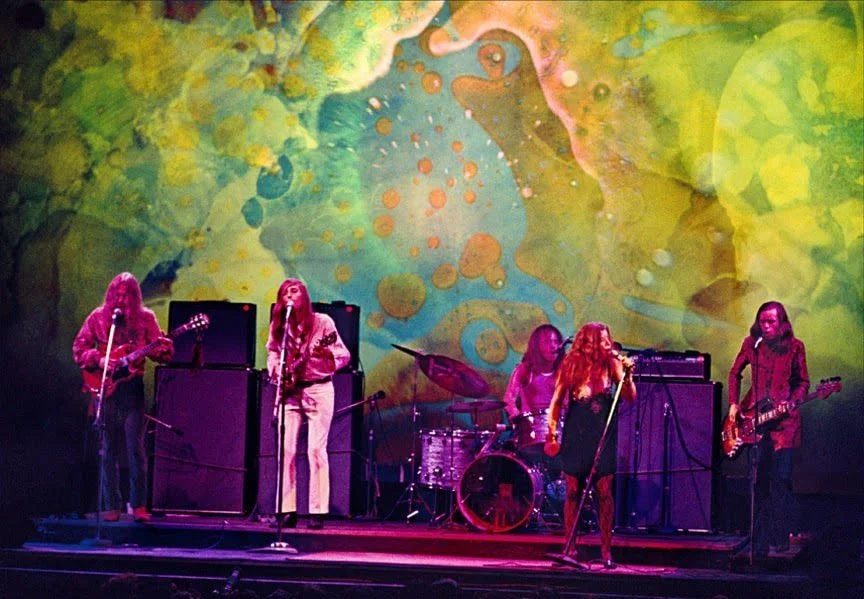
Big Brother and the Holding Company, Elliot Landy
To make the concert experience even better, Graham set up a great sound system, and he took inspiration from San Francisco’s acid tests and included a light show with Joshua Light Show, a group who had worked at the Fillmore West before and on the road touring with bands. White designed a rear-projection system with his cohort, and set up several tons of equipment on two elevated platforms about twenty feet behind the Fillmore stage. The visuals were created using slide projectors, hundreds of color wheels, reflectors including broken mirrors and aluminum foil, water and oil paints, hair dryers, two crystal ashtrays, and clear crystal clock faces. The visuals were created using pure colored light on a projector, concrete imagery including videos and photos on another projector, reflections with mirrors and glass called “lumia,” and yet another projector showed colored oil and water dyes in between the crystal clock faces.
Every weekend at the Fillmore East, the light show performed multiple shows for up to ten thousand people. The projections set the venue apart from others, and some people went to shows just to see the lights.
The energy of the crowd, acoustics, and Graham's innovative and personal way of handling concerts, the Fillmore East made many artists want to return time and time again, and most put out live albums of their shows recorded at the venue. Most notably, these live albums include The Allman Brothers Band’s “At Fillmore East”, Grateful Dead’s “Skull and Roses”, Jimi Hendrix’s “Band of Gypsys”, and Janis Joplin’s “Fillmore East 1969”.
Despite the great press, bands, and audiences, Graham felt burned out and unenthusiastic for rock concerts, which had started turning into stadium shows. The Fillmores were just too small for the bands and their fans, and on June 27, 1971, the Fillmore East hosted its last show. The Allman Brothers, the J. Geils Band, Albert King, and special surprise guests Edgar Winter’s White Trash, Mountain, the Beach Boys and Country Joe McDonald played on the stage for the last time. Although its run was short, Bill Graham’s Fillmore East gave fans more than their money’s worth, and gave many bands a shot into stardom.
Today, the Fillmore East lobby on Second Avenue is a bank, and the concert hall has been turned into apartments. Inside the bank lobby are pictures and memorabilia from the four-year run and the intersection of 2nd Avenue and 6th Street is honorably named Bill Graham’s Way. There is a plaque outside the bank which gives a brief history of the Fillmore, and the light post outside Mighty Quinn’s Barbeque next door is covered in a mosaic of band names, iconography and thank yous to four wonderful years of music.
Words: Skyler Martin / Thumbnail Photo: Linda Eastman